


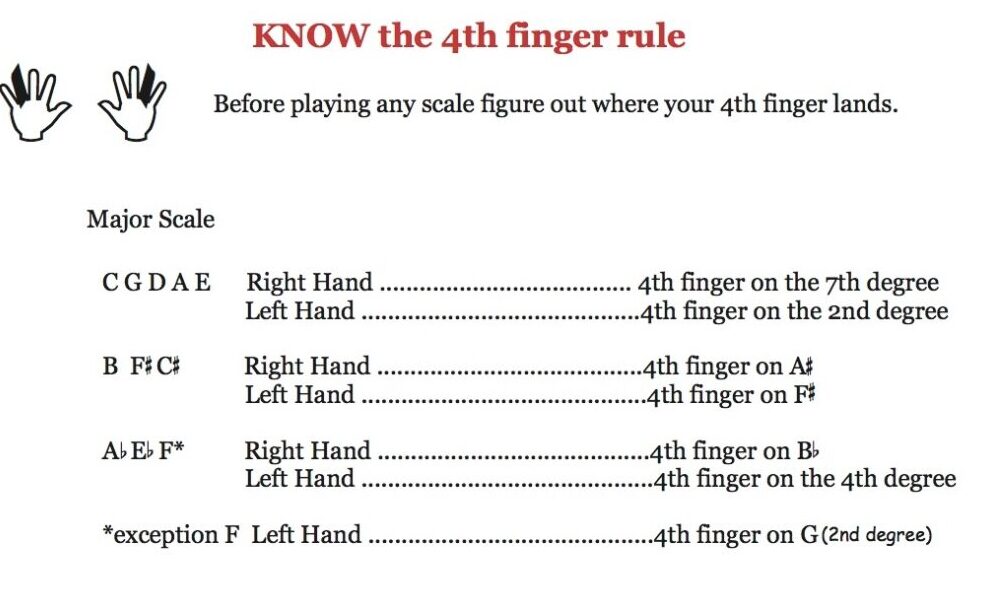
 Learn to play scales easily by knowing the 4th finger rule. Most scales that start on a white key will have this pattern.
For instance, C major scale uses the letters C D E F G A B C. For a two octave scale that has to be played twice. When starting the second octave the right hand would use finger 4 on B and the left hand finger 4 would be on D.
This is especially helpful when students start playing two octave piano scales and formula pattern scales.
Why Learn Scales?
- Scales strengthen the physical foundation of your playing or singing.
- Piano players will develop finger coordination, control and agility.
- Scales help you understand music theory. Scales are the alphabet of music. Melody, harmony and chord progressions come from this musical alphabet.
- Learning scales deeps your understanding of Key Signatures, Chord relationships, melodic structure. When you know your scales you can start seeing how the music fits together. This makes it easier to memorize a piece or even compose your own music.
- Scales Improve Ear Training As you practice scales, your ear learns to recognize the distance between notes.
- Scales Build Confidence on Stage. If you understand the key your piece is in and the scales that creates the piece, confidence is knowing that even if you hit the wrong note you can get right back into the piece by understanding the notes that are in that scale.
- Scales are not just practice drills, but confidence boosters.
HEY! there are 7 tones to a heptatonic scale.
“Tonic” referes to tones or pitches. So heptatonic literally means “seven tones”
Most of the common Western scales you hear in classical, pop, and jazz music are heptatonic.


